
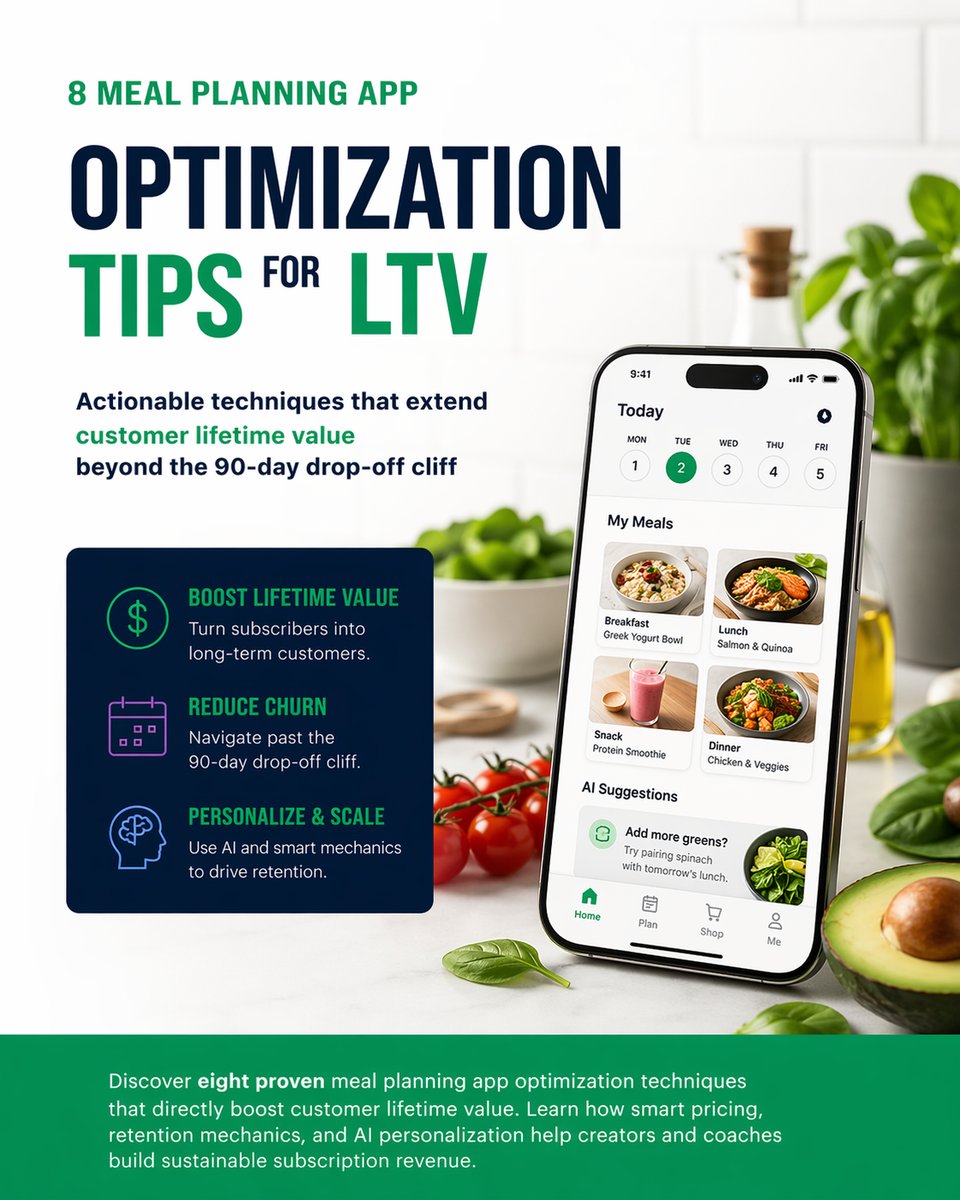
Actionable techniques that extend customer lifetime value beyond the 90-day drop-off cliff
Discover eight proven meal planning app optimization techniques that directly boost customer lifetime value. Learn how smart pricing, retention mechanics, and AI personalization help creators and coaches build sustainable subscription revenue.
TL;DR
LTV is a system, not a metric - Activation, retention, pricing, and AI personalization compound on each other when sequenced correctly.
Churn reduction beats acquisition - Cutting monthly churn by one point shortens the 42-month CAC payback more than any ad campaign.
Annual billing and AI tiers raise ARPU - ARPU can climb from $825 to $1,430 by optimizing product mix and billing cadence.
Segment by use case, not diet - Time-based positioning for busy professionals outperforms saturated dietary angles.
Start with one to three techniques - Pick the one tied to your weakest metric, commit 60 days, then move on.
1. The Hidden Economics of Meal Planning Apps
Meal planning app optimization has shifted from feature races to financial engineering. The apps winning in 2025 are not the ones with the longest recipe libraries. They are the ones extending customer lifetime value through retention mechanics, smart pricing tiers, and AI-driven personalization that keeps busy professionals engaged past the 90-day drop-off cliff.
For food creators, nutritionists, and coaches launching branded apps, this distinction matters. Blended ARPU is projected to climb from $825 to $1,430 between 2026 and 2030, but only for operators who optimize product mix, billing cadence, and churn. The gap between average and exceptional LTV is widening fast.
2. The Promise: What This List Covers
This guide is for food content creators, health coaches, and wellness professionals running subscription meal planning apps aimed at busy professionals. It excludes generic growth hacks, vanity metrics, and advice that ignores unit economics. Instead, you get eight optimization techniques that directly move customer lifetime value, each tied to a specific lever: acquisition efficiency, activation, retention, expansion, or monetization.
3. The Criteria
Each technique had to meet three tests: measurable LTV impact, feasibility for a solo operator or small team, and durability beyond short-term trends. Tactics tied only to a single platform algorithm were excluded. Every item connects to either reducing CAC payback time or extending revenue per user.
4. Eight Techniques That Enhance Customer Lifetime Value
1. Engineer Trial-to-Paid Conversion Around First Value
Why it matters: Busy professionals judge a meal planning app within the first session. If they do not receive a usable week-one plan fast, they churn before billing starts. Trial length means nothing without activation.
What it looks like today: Top apps front-load a guided onboarding that captures dietary preferences, schedule, and household size, then generate a personalized plan in under three minutes. They trigger a shopping list export or calendar sync as the "aha" moment.
How to apply it: Measure time-to-first-plan and time-to-first-grocery-list. Aim for under five minutes. Send a day-two email asking about the first meal cooked, not the app itself. Platforms like Member Kitchens ship with preconfigured onboarding flows so you can launch with activation mechanics already built in.
2. Reduce Monthly Churn by One Percentage Point
Why it matters: With CAC at $13 and payback periods stretching to 42 months, churn reduction is the highest leverage point for LTV. A single percentage point of monthly churn reduction can meaningfully shorten payback and expand lifetime revenue per user.
What it looks like today: Operators use exit surveys, pause-instead-of-cancel flows, and winback offers triggered at cancellation. They identify churn predictors (days since last plan generated, unopened emails) and intervene before the cancel click.
How to apply it: Build a churn dashboard with three inputs: login frequency, plan generation, and shopping list exports. Trigger a human check-in or automated nudge when any metric drops 40% week-over-week. Offer a pause option of 30 to 60 days instead of cancellation.
3. Shift Billing Cadence to Annual
Why it matters: Monthly billing compounds processing fees and exposes you to seasonal cancellation spikes (January start, February quit). Annual plans smooth cash flow and raise the switching cost.
What it looks like today:Annual billing can reduce payment processing fees from 20% to 15% by 2030. Apps offer a two-month discount for annual prepay, typically pricing annual at 10x the monthly rate.
How to apply it: Present annual as the default tier at checkout. Use anchoring: show monthly first, then highlight annual savings. Target 30 to 40% of new subscribers on annual within six months.
4. Layer an AI Personalization Tier
Why it matters:Personalized experiences in AI-driven meal planning apps can increase engagement by up to 80%, and 42% of leading apps already incorporate AI/ML for recommendations. A premium AI tier captures willingness-to-pay from power users without alienating budget subscribers.
What it looks like today: AI assistants suggest substitutions based on pantry inventory, adapt weekly plans to calendar load, and generate macro-matched variations. Users pay 40 to 60% more for this tier.
How to apply it: Launch one AI feature that solves a real friction point, such as automatic recipe scaling or leftover repurposing. Gate it behind a premium tier. Measure attach rate, not download count.
5. Segment by Professional Use Case, Not Diet
Why it matters: "Keto" and "vegan" are saturated positioning angles. Busy professionals respond to time-based framing: 20-minute meals, one-pan dinners, Sunday prep for the week. This sharpens user acquisition strategies and raises trial conversion.
What it looks like today: Successful apps segment landing pages by occupation or lifestyle (consultants, parents with young kids, shift workers) with copy, testimonials, and meal examples tailored to each.
How to apply it: Build three segment-specific landing pages, run paid traffic to each, and compare trial-to-paid conversion. Double down on the segment with the highest LTV, not the highest click-through rate.
6. Build a Referral Loop Tied to Adherence
Why it matters: Referral CAC is typically 40 to 70% lower than paid channels. Users who refer friends also retain longer, creating a compounding LTV effect.
What it looks like today: Apps reward users after they complete a meaningful adherence milestone (four weeks of plans cooked, first grocery list shared) rather than at signup. The reward is usage-based: a free month, a premium recipe pack, a one-on-one coaching call.
How to apply it: Trigger referral prompts after adherence events, not after payment. Keep the reward on-brand (content, access) rather than cash to avoid attracting low-intent users.
7. Instrument Five Metrics, Not Fifty
Why it matters: Most operators drown in dashboards. LTV optimization requires a short list of metrics reviewed weekly, each tied to a decision.
What it looks like today: The five that matter: trial-to-paid conversion, 30-day retention, monthly churn, ARPU, and CAC payback period. Every product change should map to moving one of these.
How to apply it: Review these five numbers weekly. If a feature or campaign does not affect any of them within 60 days, kill it. For deeper diagnosis, see why subscribers aren't converting.
8. Use a No-Code Platform to Compress Iteration Cycles
Why it matters: Custom-built apps consume 6 to 18 months before first revenue and lock you into whatever decisions you made on day one. Speed of iteration is an LTV lever because it lets you test retention features monthly instead of annually.
What it looks like today: Creators launch branded meal planning apps in days using white-label platforms, then redirect budget toward acquisition and retention experiments. See more on building a no code meal planning app.
How to apply it: Spend the first 90 days validating demand and pricing, not polishing features. Use saved engineering time to run at least two pricing tests and two onboarding tests.
5. Pattern Recognition: LTV as an Integrated System
These techniques share a common thread: they treat customer lifetime value as a system output, not a single metric. Activation feeds retention. Retention funds better pricing tiers. Better tiers justify AI investment. AI personalization deepens engagement, which lowers churn, which extends LTV, which funds acquisition.
The tradeoff is focus. Operators who try to optimize everything at once move nothing. The apps extending LTV fastest make sequential bets: fix activation first, then churn, then expansion revenue. Second-order effects follow: higher LTV unlocks higher CAC ceilings, which opens previously unaffordable acquisition channels. This is how AI personalization compounds into long-term loyalty rather than a feature gimmick.
6. Constraints and Prioritization
You do not need to implement all eight techniques. Start with one to three based on your stage. Pre-launch: focus on segmentation (#5) and platform choice (#8). Under 500 subscribers: prioritize trial-to-paid (#1) and metrics instrumentation (#7). Over 500 subscribers: attack churn (#2), annual billing (#3), and AI tiering (#4).
Resource constraints are real. A solo creator cannot run six experiments in parallel. Pick the technique tied to your weakest metric, commit 60 days, measure honestly, then move to the next.
Frequently Asked Questions
What are the key steps to launch a meal planning SaaS app?
Validate demand with a specific audience segment, define two or three pricing tiers, choose a no-code or white-label platform to compress time-to-market, instrument five core metrics from day one, and allocate budget toward acquisition and retention experiments rather than feature expansion.
Why is it important to define product tiers and pricing before launching?
Pricing tiers shape your unit economics, positioning, and product roadmap. Launching without them forces reactive decisions and anchors users to the lowest-value version. Defined tiers also let you test willingness-to-pay for premium features like AI personalization, which can lift ARPU by 40 to 60%.
When should I implement a performance marketing strategy?
Only after you have proven a trial-to-paid conversion rate above 15% and a 30-day retention rate above 60%. Paid acquisition amplifies whatever funnel you have. If activation or retention is weak, paid traffic accelerates losses rather than growth.
Which metrics should I monitor to track breakeven?
Focus on five: trial-to-paid conversion, 30-day retention, monthly churn, ARPU, and CAC payback period. With CAC near $13 and payback periods around 42 months, small improvements in churn or ARPU dramatically shorten the path to breakeven.
How can I optimize the trial-to-paid conversion rate?
Shorten time-to-first-value. Users should generate a personalized plan and shopping list within the first five minutes. Follow up on day two with a question about their first cooked meal, not about the app. Present annual billing as the default at checkout to increase both conversion value and retention.
How do I reduce churn without cutting prices?
Build a churn dashboard tracking login frequency, plan generation, and shopping list exports. Trigger interventions when activity drops 40% week-over-week. Offer pause options of 30 to 60 days instead of cancellation, and run exit surveys to identify the top three churn drivers you can fix in product.
Sources
https://financialmodelslab.com/blogs/profitability/nutritionist-meal-planning-app
https://market.us/report/ai-driven-meal-planning-apps-market/
https://www.businessresearchinsights.com/market-reports/meal-planning-app-market-113013
https://memberkitchens.com/blog/why-aren-t-people-subscribing-to-my-meal-plan-service
https://memberkitchens.com/blog/tips-for-building-your-own-no-code-meal-planning-app