
How food content creators can build recurring income and lasting client relationships beyond affiliate deals
Learn how subscription meal plans help food creators convert followers into paying members. This guide covers a four-stage engagement framework, automation strategies, and retention tactics to beat the 90-day churn window.
TL;DR
Subscription beats delivery for creators - You own the client relationship, branding, and retention data instead of renting it from a meal kit partner.
Retention is an engineered system - Use a four-stage framework: intake, delivery, feedback, and adaptation. Each stage feeds the next automatically.
Automated feedback handling is the core - Structured ratings and check-ins drive personalization at scale and predict churn before it happens.
Narrow thesis outperforms broad content - A specific promise to a specific audience retains better and justifies premium pricing.
Launch lean, then layer - Start with intake and weekly delivery, add feedback loops in month two, and build re-engagement triggers once you have enough data.
Guide Orientation
This guide shows food content creators how to use subscription meal plans to build recurring revenue and long-term client relationships, rather than relying on one-off recipe sales or affiliate commissions from traditional meal delivery systems. You'll learn the core differences between the two models, a four-stage engagement framework, and six practical steps to automate onboarding, feedback, and retention.
This is written for influencers, bloggers, and creator-coaches who already have an audience and want to convert passive followers into paying members. By the end, you'll be able to design an automated engagement loop that keeps subscribers active beyond the typical 90-day churn window, without adding hours of manual work each week.
Why Subscription Meal Plans Matter Right Now
The creator economy has shifted. Ad revenue is unpredictable, sponsorships fluctuate, and static PDF cookbooks sell once and never again. Meanwhile, the global food subscription market is projected to grow from $6.74 billion in 2026 to $14.42 billion by 2034, a compound annual growth rate of nearly 10%. Consumers are increasingly comfortable paying recurring fees for food-related guidance, not just boxed ingredients.
This matters because traditional meal delivery systems, HelloFresh, Blue Apron, and similar kit services, own the logistics relationship with the customer. Creators who partner with them earn affiliate income, but they don't own the client relationship, the data, or the retention curve. When the subscriber cancels the kit, the creator loses the audience touchpoint entirely.
Subscription meal plans flip that dynamic. The creator owns the plan, the branding, the communication cadence, and the feedback loop. Monthly subscription models are expected to capture roughly 42% of the meal kit market by 2026, signaling that consumers prefer predictable, recurring engagement over one-time purchases. The cost of ignoring this shift is stark: creators who stay locked into transactional content, selling the same ebook repeatedly, face flat revenue while competitors build compounding monthly recurring revenue.
Core Concepts: Subscription Plans vs. Traditional Meal Delivery
The Fundamental Distinction
A traditional meal delivery system ships physical ingredients. The value is logistical: convenience, portion control, and reduced grocery trips. A subscription meal plan delivers structured guidance, personalized recipes, shopping lists, and progress tracking, without the logistics burden. The creator's value is expertise and curation, not fulfillment.
Engagement vs. Transaction
Most creators think of their audience in transactional terms: a purchase, a download, a click. Subscription models require a relational frame. Retention is measured in months active, not units sold. This means success depends on whether a subscriber feels continuously supported, not whether they got a good deal on week one.
Automated Feedback Handling
Automated feedback handling is the system that collects subscriber responses, recipe ratings, adherence check-ins, dietary adjustments, and routes them back into the plan without manual intervention. Without it, personalization collapses at scale. With it, a creator can serve 500 subscribers with the same effort previously required for 20.
Common Misconceptions
Many creators assume subscription success is about content volume. It isn't. A plan with 12 well-structured weekly menus and strong feedback loops outperforms one with 200 unstructured recipes. Another misconception: that automation feels impersonal. Done well, automation frees the creator to show up personally at the moments that matter most, milestones, plateaus, and cancellations.
The Retention-Focused Engagement Framework
Use this four-stage framework as the spine of your subscription offering:
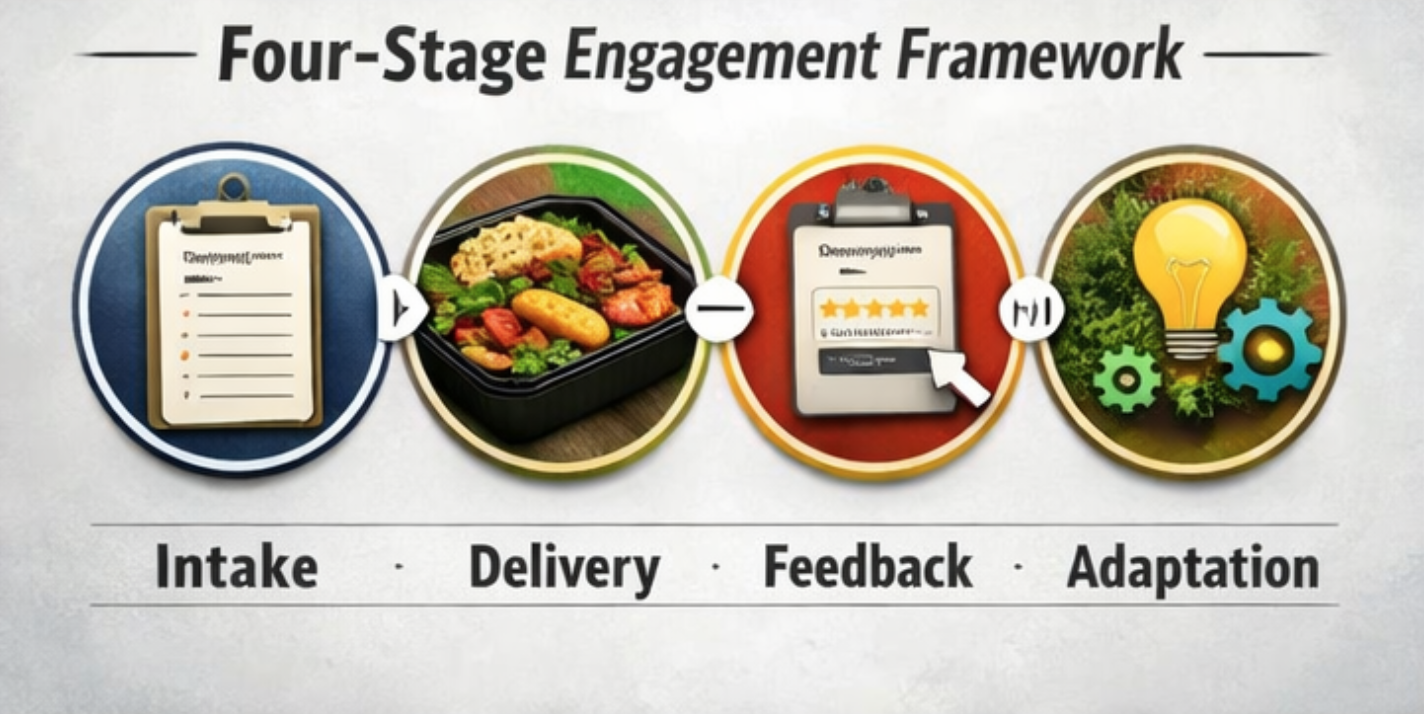
Stage 1: Intake. Capture dietary preferences, goals, household size, and constraints before the first plan is delivered.
Stage 2: Delivery. Send personalized weekly plans, shopping lists, and prep guidance on a predictable schedule.
Stage 3: Feedback. Collect structured input on adherence, recipe satisfaction, and progress at set intervals.
Stage 4: Adaptation. Use feedback signals to adjust future plans, trigger re-engagement messages, or escalate to human coaching when churn risk appears.
Each stage feeds the next. Intake data informs delivery; delivery outcomes drive feedback; feedback reshapes adaptation, which loops back into the next delivery cycle. This is the opposite of a meal kit box, which repeats the same delivery regardless of whether the customer loved week three or skipped it entirely.
Step-by-Step Breakdown
Step 1: Define Your Subscription Thesis
Objective: Establish a clear, narrow promise that justifies recurring payment.
Your thesis answers a simple question: what specific outcome does a subscriber get month after month that they can't get from a one-time purchase? "High-protein Mediterranean meals for busy parents" is a thesis. "Healthy recipes" is not. The narrower the thesis, the higher the retention, because subscribers self-select based on fit rather than curiosity.
Execution guidance: Write a one-sentence thesis. Test it against three criteria: Is it specific to an audience? Does it promise ongoing value? Does it differentiate from free content? If you price your offering, aim for the premium end of the market. Typical meal planning memberships range from $5 to $20 per month, but creators with strong theses and automated personalization command more.
Anti-patterns: Trying to serve every dietary style. Copying a competitor's positioning. Leading with price instead of outcome.
Success indicators: Prospective subscribers can repeat your thesis back to you after one landing page visit.
Step 2: Build an Automated Intake Flow
Objective: Capture enough data at signup to personalize the first delivery without a human in the loop.
The intake form is the foundation of every future automation. Ask about dietary restrictions, allergens, cuisine preferences, household size, cooking skill level, available prep time, and goals. Keep it under eight questions, abandonment climbs sharply beyond that threshold.
Execution guidance: Map each intake field to a downstream automation. If you ask about allergens, your recipe database must be tagged to filter them. If you ask about prep time, your weekly plan must adjust recipe complexity accordingly. Platforms like Member Kitchens handle this mapping natively, letting you launch a branded app with intake-to-plan automation in place without writing code.
Anti-patterns: Collecting data you won't use. Asking for the same information twice. Delivering a generic plan after a detailed intake, this destroys trust immediately.
Success indicators: First-week adherence above 70%, measured through recipe views or check-ins.

Step 3: Automate Weekly Plan Delivery
Objective: Deliver personalized plans on a reliable cadence without manual assembly.
Predictability is a retention driver. Subscribers who know their plan arrives every Sunday morning plan their grocery trips around it. Miss that window twice and cancellation conversations begin. Automated delivery means templates, tags, and scheduling rules do the work.
Execution guidance: Choose one delivery day and one delivery channel. Include the week's menu, an automated shopping list grouped by grocery aisle, and prep instructions. If you're still sending static PDF meal plans, you're carrying hidden costs: no update mechanism, no engagement data, and no way to adjust mid-week.
Anti-patterns: Inconsistent delivery timing. Attaching a giant PDF instead of an interactive interface. Sending the same plan to every subscriber regardless of intake data.
Success indicators: Open rates above 60% and recipe views above 50% within 48 hours of delivery.
Step 4: Implement Structured Feedback Loops
Objective: Collect actionable subscriber input on a schedule, without survey fatigue.
Feedback is the fuel for retention. But asking "How are we doing?" generates noise. Structured feedback asks specific questions at specific moments: rate this recipe, did you skip any meals this week, how is your energy compared to last month.
Execution guidance: Build three feedback touchpoints. A post-recipe rating (one tap), a weekly adherence check-in (two questions), and a monthly progress review (five questions). Automate reminders only when responses are missing. Route low ratings into a recipe-exclusion list so the subscriber never sees that dish again.
Anti-patterns: Long surveys. Asking for feedback without acting on it. Treating feedback as marketing research instead of a personalization input.
Success indicators: Response rates above 30% on weekly check-ins and measurable week-over-week improvements in recipe ratings.
Step 5: Trigger Re-Engagement Automations
Objective: Identify at-risk subscribers before they cancel and intervene automatically.
Churn is rarely a surprise. Subscribers disengage for two to three weeks before they cancel. Engagement signals, login frequency, recipe views, shopping list downloads, predict churn with high accuracy if you track them.
Execution guidance: Define a disengagement threshold (for example, no logins for 10 days). Trigger a sequence: a personalized check-in message, a plan-adjustment offer, and finally a direct outreach from you. Keep the first two automated and reserve human contact for high-value or long-tenure subscribers. This is where a white-label meal planning app pays off, you see engagement data in one place rather than stitching it together manually.
Anti-patterns: Discount-heavy win-back campaigns that train subscribers to disengage. Generic "we miss you" messages.
Success indicators: 20% or higher reactivation rate among subscribers who trigger the flow.
Step 6: Review and Refine Quarterly
Objective: Treat the subscription as a product that improves, not a content library that accumulates.
Every quarter, audit your metrics: signup conversion, first-month retention, 90-day retention, average subscriber lifetime, and top-rated versus bottom-rated recipes. Retire recipes with consistently low ratings. Expand themes that drive engagement. Adjust intake questions based on what actually predicts retention.
Execution guidance: Block two hours per quarter for this review. Document one change per cycle and measure its impact.
Success indicators: 90-day retention improves by three to five percentage points year over year.
Practical Example: From Blog to Branded Subscription
Consider a food blogger with 40,000 Instagram followers focused on Mediterranean cooking. Her previous revenue came from affiliate links to meal kit services, earning roughly $800 per month with no control over the customer relationship. She launched a branded subscription at $19 per month with a narrow thesis: weekly Mediterranean meal plans for working professionals.
The intake asked six questions. Weekly plans auto-delivered each Sunday with grouped shopping lists. Recipe ratings fed a learning loop that removed disliked dishes within two weeks. A disengagement trigger fired after 10 days of inactivity, recovering roughly one in four at-risk subscribers.
Within six months, 420 active subscribers generated predictable monthly revenue that far exceeded her prior affiliate income, with the added benefit of owning the audience relationship. The key shift was not content volume but engagement architecture.
Common Mistakes and Pitfalls
Launching without a thesis. Generic meal plans compete on price and lose. Premium positioning requires specificity.
Over-automating early communication. The first two weeks are when subscribers decide to stay. Automated workflows should feel personal, with your voice and tone, not transactional.
Ignoring low-engagement subscribers. They churn quietly. Build triggers before you need them.
Confusing content creation with product development. Adding more recipes rarely improves retention. Improving the feedback-to-adaptation loop almost always does.
Competing with meal kit logistics. You're not a shipping company. Your value is expertise, curation, and ongoing guidance.
Treating feedback as optional. Without structured input, personalization is a marketing claim, not a reality.
Each of these failure modes is common and recoverable. The creators who build durable subscription businesses are the ones who treat retention as a system, not a hope.
What to Do Next
Start with your thesis. Write one sentence that describes who you serve and what recurring outcome you deliver. Test it on five members of your audience before building anything else.
From there, sketch your intake questions and your weekly delivery cadence. You don't need to build all four framework stages at once. Launch with intake and delivery, add feedback loops in month two, and layer re-engagement triggers once you have enough data to see churn patterns.
Treat this guide as a reference rather than a checklist. Revisit it as your subscriber base grows and your engagement data reveals what actually drives retention in your specific niche.
Frequently Asked Questions
What is the difference between a subscription meal plan and a meal delivery system?
A meal delivery system ships physical ingredients and owns the logistics relationship. A subscription meal plan delivers personalized guidance, recipes, shopping lists, and progress tracking, letting the creator own the client relationship, branding, and retention data without handling fulfillment.
Why should food content creators use subscription meal plans instead of affiliate partnerships?
Affiliate partnerships pay once and give you no control over the customer relationship. Subscription meal plans generate recurring revenue, compound over time, and let you use engagement data to improve retention. You also own the audience, which protects your business from platform or partner changes.
How do I automate feedback handling without making it feel impersonal?
Use structured, low-friction touchpoints: one-tap recipe ratings, two-question weekly check-ins, and short monthly reviews. Act visibly on the feedback by removing disliked recipes and adjusting plans. Reserve personal outreach for milestones, plateaus, and cancellation risks where your voice matters most.
What features should I look for in a meal planning SaaS?
Prioritize automated intake-to-plan mapping, dynamic shopping lists, recipe tagging for dietary filters, engagement analytics, and white-label branding. These features support the four-stage engagement framework without requiring custom development or technical staff.
When should I launch a subscription meal plan versus continuing with one-off products?
Launch when you have a clearly defined audience niche, a narrow thesis you can articulate in one sentence, and at least a small engaged following willing to give feedback during a beta period. You don't need a huge audience, you need a specific one.
How much should I charge for a subscription meal plan?
Typical meal planning memberships range from $5 to $20 per month, but creators with strong theses, personalization, and premium positioning regularly charge more. Price based on the outcome you deliver, not on what competitors charge, and test two or three price points during your first six months.