

Why the real price of generic software is measured in lost client trust, not monthly fees
Discover why stacking disconnected nutrition tools erodes your professional credibility and client retention. This piece reframes nutrition software pricing as a revenue decision, not a budget line item.
TL;DR
Generic tools fragment your brand - Five disconnected subscriptions create five inconsistent client touchpoints, quietly eroding trust and making referrals harder.
The real cost is invisible - It's not the subscription fees. It's the renewals that don't happen, the screenshots that never get shared, and the referrals that stay vague.
Count touchpoints, not features - Every login, email, and PDF header either reinforces your brand or dilutes it. A unified, branded experience turns your practice into a product clients want to subscribe to.
This is a business model decision, not a tech upgrade - Moving to a white-label solution like Member Kitchens is a revenue and retention calculation, not a line item on a budget spreadsheet.
Your Clients Don't Know Your Software Stack. They Know How You Make Them Feel.
Here's something that rarely shows up in a nutrition software pricing comparison: the moment a client opens a generic app, sees someone else's logo, and quietly wonders whether they're getting a real professional or just another reseller. That moment costs you more than any subscription fee ever will.
The subscription-based nutrition app market is booming. The tools available to dietitians and coaches have never been more plentiful. But "more tools" and "better practice" are not the same thing. Not even close.
The Toolbox Fallacy in Nutrition Software Pricing
The conventional approach goes like this: find a tool for meal planning, another for client communication, a third for scheduling, maybe a fourth for grocery lists, and a fifth for branded PDF delivery. Each one solves a narrow problem. Each one has its own login, its own design language, its own billing cycle.
This patchwork model became popular because individual tools are easy to adopt. You sign up, watch a tutorial, start using it tomorrow. No commitment, no integration headaches upfront. It feels lean and flexible.
But over time, something shifts. You're spending more hours stitching workflows together than actually coaching. Your clients receive communications that look different every time. And the flexibility you valued in month one becomes friction by month six. The real cost isn't the $30 or $50 per tool. It's the professional credibility that leaks out through every inconsistent touchpoint. In fact, RingCentral research found the average worker loses 32 full days a year just toggling between disconnected apps.
The Moment the Math Changes
We believe the decision to move beyond generic tools isn't a technology upgrade. It's a business model decision. The question isn't "which features do I need?" It's "what does my client experience when they interact with my practice digitally, and is that experience building trust or eroding it?"
When you frame it that way, the entire conversation shifts from cost-per-feature to revenue-per-client.
Why Disconnected Tools Break Before Your Practice Does
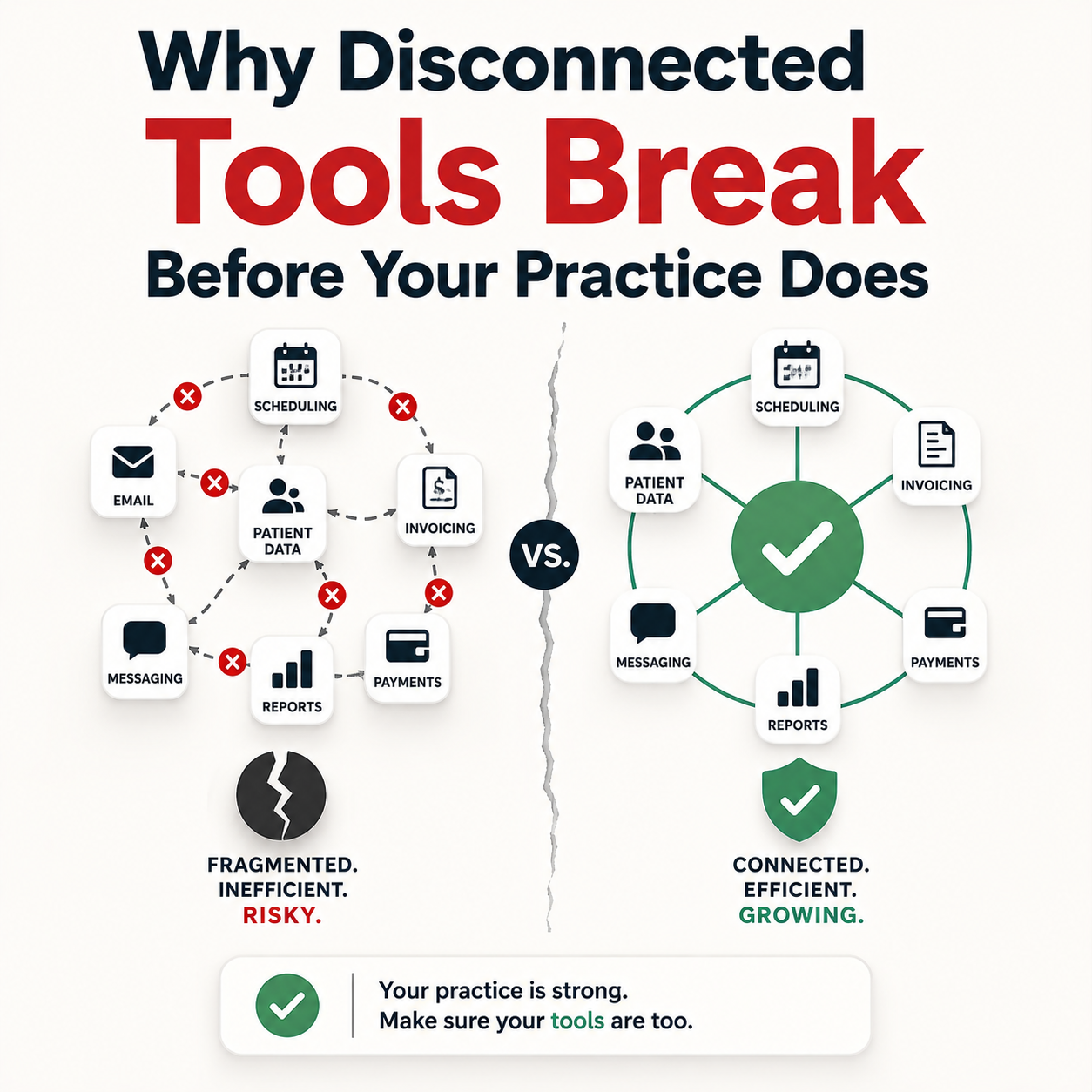
Consider a dietitian with 40 active clients. She uses one platform for meal plans, exports PDFs, emails them through a second tool, tracks progress in a spreadsheet, and manages payments through a fourth service. She's competent. She's busy. And she's completely invisible as a brand.
Her clients interact with four different interfaces, none of which carry her name, her colors, or her voice. When they recommend her to a friend, they can't point to a single cohesive experience. They say, "She's great, she sends me stuff." That's not a referral engine. That's a whisper.
Now contrast that with a coach whose clients open one app, see her brand, browse personalized meal plans, tap through automated shopping lists, and receive push notifications for meal plans on their schedule. Every interaction reinforces the same identity. Every touchpoint says: this is a professional practice, not a side hustle.
The data backs this up. Health and fitness apps carry the highest install lifetime value of any app category at $1.21 per install globally. That number isn't driven by feature density. It's driven by perceived value and commitment. When clients feel like they belong to something cohesive, they stay longer and pay more willingly.
And the market is moving fast. The global diet and nutrition apps market was valued at $2.14 billion in 2024 and is projected to more than double by 2030. Within that market, subscriptions already deliver nearly 45% of total revenue. The professionals capturing that recurring revenue aren't the ones with the most tools. They're the ones with the most trust.
This is where the white-label decision stops being about software and starts being about positioning. A client portal for dietitians that carries your brand isn't a vanity play. It's the difference between being a commodity ("my nutritionist uses some app") and being a destination ("I use Sarah's app").
Platforms like Member Kitchens exist precisely for this inflection point, letting nutrition professionals launch their own branded meal-planning app without writing code or hiring a design agency. The platform handles the technical layer so you can focus on the thing that actually differentiates your practice: your expertise and your relationship with clients.
But even beyond any single platform, the principle holds. The moment you realize your software stack is fragmenting your client's experience rather than enhancing it, you've outgrown generic tools. That realization is the signal.
What You Lose by Waiting
If this thesis is right, then every month spent stitching together disconnected tools is a month where client retention quietly declines, referrals stay informal instead of organic, and your practice remains operationally busy without becoming strategically stronger. Research backs this up: consistent brand presentation across all touchpoints can drive up to 33% more revenue, a gain that's hard to reach when your tools pull clients in different directions.
The cost isn't dramatic. Nobody cancels because your PDF looked generic. They just don't renew with the same enthusiasm. They don't screenshot your meal plan and share it. They don't tell their coworker, "You have to try this app." The absence of those moments is invisible, which is exactly what makes it dangerous.
The enterprise B2B licensing segment in nutrition apps is forecast to grow at a 15.37% CAGR, driven by organizations paying for measurable health outcomes. Individual practitioners who can demonstrate a branded, trackable, professional experience will increasingly compete for those same dollars. The ones still emailing PDFs will not.
Stop Counting Tools. Start Counting Touchpoints.
Here's the reframe we keep coming back to: your software stack isn't a list of features. It's a client experience you're designing, whether you realize it or not.
Every login screen, every email template, every PDF header is a touchpoint. And every touchpoint either reinforces your brand or dilutes it. The question isn't how many tools you have. It's how many of those touchpoints feel like you.
When a nutrition professional moves from scattered generic tools to a unified, branded experience (whether through building a no-code app or migrating from PDFs to an interactive platform), the shift isn't technical. It's perceptual. Clients start treating the practice like a product they subscribe to, not a service they tolerate.
The Practices That Scale Are the Ones That Feel Like One Thing
You don't need more software. You need fewer seams. The practices pulling ahead right now aren't the ones with the longest feature checklists. They're the ones where a client can move from discovery to meal plan to grocery store without ever leaving the practitioner's world.
That's not a technology problem. That's a clarity problem. And the practitioners who solve it first will be the ones still growing when the market doubles.
Frequently Asked Questions
When is it beneficial to switch from a generic meal planning tool to a white-label solution?
The clearest signal is when your clients interact with multiple disconnected interfaces that don't carry your brand. If you're spending more time managing tools than coaching clients, and your referrals feel informal rather than organic, you've likely outgrown generic software.
What is a white-label meal planning app?
It's a meal planning application built and maintained by a platform provider but branded entirely as yours. Your clients see your name, your logo, and your design, creating a seamless professional experience without requiring you to build or code anything yourself.
How does a branded mobile app enhance client engagement?
A branded app consolidates every client touchpoint (meal plans, grocery lists, notifications) under one identity, which builds familiarity and trust. Clients who feel they belong to a cohesive experience are more likely to stay subscribed and refer others.
Sources
https://www.ringcentral.com/us/en/blog/communications-apps-impact-digital-workplace-research-series/
https://adapty.io/blog/health-fitness-app-subscription-benchmarks/
https://www.grandviewresearch.com/industry-analysis/diet-nutrition-apps-market-report
https://www.mordorintelligence.com/industry-reports/diet-and-nutrition-apps-market
https://memberkitchens.com/blog/how-to-make-a-meal-planning-app-without-coding
https://memberkitchens.com/blog/pdf-meal-plans-to-interactive-app